Tuesday, August 6, 2013

Stolen Generations

The Stolen Generations are the Noongar and other Aboriginal children who, over one and a half centuries, were taken away from their families and placed in institutions and missions. Most often it was the lighter skinned children who were taken to be assimilated into white society. Sometimes children were on their way home from school or visiting their siblings when they were taken.
 History of the Stolen Generations
The first recorded removal of a Noongar child in the Swan River Colony was in 1833. Lt. Governor Irwin wrote to his superiors in London after the execution of Noongar Elder, Midgegooroo. Irwin writes in relation to Midgegooroo’s eight-year-old son, Billy. ‘The Child has been kept in ignorance of his father’s fate and it is my present intention to retain him in confinement and by kind treatment I am in hopes from his tender age, he may be [accustomed] to civilised habits, as to make it improbable he would revert to a barbarous life when grown up.’[i] The systematic removal of Aboriginal children was set in place with the increase of missions and the introduction of the 1905 Act. Many children were also removed from their families before this period.
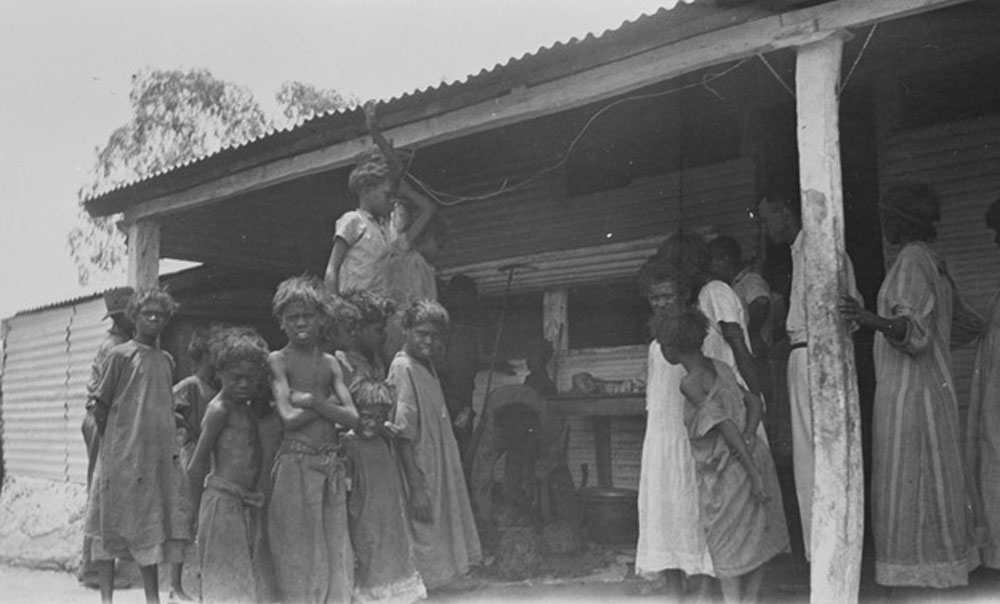
Children at Moore River Native Settlement, 1930s. Courtesy State Library of Western Australia, The Battye Library 226017PD

Four months later, after repeated requests, he was returned to his mother. Billy’s removal was not legal, but like other cases in the early years of colonialism, little was done to stop it. The impact of colonisation on Noongar children began early on with the violent conflict between Noongar and Europeans over land, laws, and vast differences in culture and perspective. Over the next one and a half centuries, successive generations of European settlers sought to impose European values and behaviour on the Aboriginal population. They did so with the deliberate and calculated removal of Noongar and other Indigenous children from their families. The children were confined in government and church-sponsored institutions, where they were to be re-educated and Christianised.


Missions

With the arrival of the Christian missions came the first systemic removal of Noongar children.[ii] From the point of view of the missionaries, their work was to ‘save the souls’ of the Aboriginal race. For Noongar it meant fear of police and cars carrying officers from the Welfare Department.
 Doolan Leisha Eatts recalls her time at the Badjaling Mission:
[A]t the Badjaling Mission, you know everyone was camped along. We were camped right up at the sand plain, up the top there. And when the car comes in down the bottom, come in like that, well the bottom camp they all had a young fella who was trained to whistle long and sharp for danger if there was a car coming in. And so young fella would give this long sharp whistle and it be carried on with every young fella in the family too, and it would get up to the camp where we were. And of course all the kids used to run and ‘ide.
Doolan Leisha Eatts, oral history, SWALSC, 2008

 Legal removal of Indigenous Children

The first law in Western Australia to officially sanction the removal of children was the Industrial Schools Act of 1874. It stated that, ‘any Indigenous child “surrendered” to an institution could be detained there without parental consent, or contracted to employment after the age of 12 until the child reached 21 years’.[iii]

Aborigines Act, 1905

The Aborigines Act, 1905 gave the government even further control over Noongar lives. For the first time, provisions of the Act incorporated an assessment of ‘behaviour’ to determine whether an individual should be defined as Aboriginal or not. It recognized the Chief Protector of Aborigines as the legal guardian of every Aboriginal child. More consequential was his power to remove any child born of ‘half-caste’ or Aboriginal mother to a home or mission.
The number of missions and settlements in Western Australia exploded from six in 1905, to 24 in 1915, when A.O. Neville became the Chief Protector of Aborigines.[iv] Neville was a strong advocate of assimilation and thought children of mixed descent should be absorbed, racially and culturally, into the general population. His tenure was characterised by a sharp increase in the number of our Noongar children being taken from their families.


Monday, August 5, 2013

Peter Jarver, Master of Photography AIPP

  Peter Jarver,1953 - 2003
Peter Jarver Charging into electrical storms, dangling over thundering waterfalls, crawling around crocodile infested swamps, wading into flooded streams, clambering up rocky escarpments. It was all in a day’s work for photographer Peter Jarver. So was the art of waiting. Hours. Days. Months. Sometimes years.
The Adelaide-born son of Estonian parents, Peter turned his fascination with stormy weather into a career when he swapped an electrical engineering degree for a camera and moved to Darwin – home of some of the world’s biggest electrical storms.
 In the dead of night and in torrential downpours, he would be out chasing some of the 40,000 lightning flashes that split Darwin’s brooding wet season skies each year. Those giant tentacles of electricity and the menacing skyscapes they illuminated became his hallmark. It was during this period he developed an intense interest in the beautiful and unique thunderstorm activity for which this area is renowned worldwide. Not many photographers begin their careers with sky-scapes, but after years of passionate photography, he decided to expand these talents into landscape photography.
Once “nibbled” by the lightning he was trying to photograph, Peter said he had taken so many lightning shots, he could almost feel when a bolt was about to strike.
 A fervent conservationist his crystal sharp images – mostly shot in large format with a view camera and tripod – added a new and personal perspective to an old landscape format. His indulgence of ripe and fruity colours, combined with simple but dramatic composition, invoked an emotional response few could resist.
A completely self-taught photographer, Peter Jarver’s natural talent is complimented by his enthusiasm for the great Australian landscape. Long an advocate for the preservation of our natural heritage and his spiritual love of the land, his images are captured in a way few photographers can.
The measure of a great artist is not just the impact of a few images but the perception generated by a body of work.
 Peter traveled Australia for more than 20 years documenting this continent. He was passionate about this land and its fragile environment. He was acutely aware of the importance of the flora and fauna to the Australian experience and the interaction of man and the environment.
It is true to say that Peter Jarver’s body of work is a valuable archive of this country, one that can now be shared by every Australian.
Peter Jarver passed away on 24th April 2003 aged 49 years.
 Artist Statement
“Photography gives me a reason to immerse myself in a natural environment. To observe, to listen and to feel the spirit of nature is relaxing and fulfilling in itself, but to bring some images which capture the very essence of a place or a moment is truly satisfying. Time and time again I am able to transport myself to a particular place, or remember a magical moment of time when the quality of light transformed the ordinary into the extraordinary.”
“Through the images in my gallery, I hope you can also transport yourself to a time and a place where your physical being is not, but where your spirit longs to be.”
 “A true photographic artist should be able to produce images which are not just technically perfect or aesthetically pleasing, but capture the emotion or drama of the place. Water should be heard to burble, leaves to rustle. The image should be swelling with emotion, the viewer drawn by the heart into the very essence of place.”
“I believe I have achieved this and through my images I hope you can accompany me on a journey through the great Australian landscape.”


 Kakadu, a Guide for All Seasons
Kakadu, a Guide for All Seasons
The World Heritage of Kakadu is Australia's largest National Park. This guide book details the fantastic diversity of this large tropical region. The diverse wildlife, prolific bird life, ancient Aboriginal rock art and the contrast between the Wet and Dry seasons make this an informative and engaging look at one of Australia's most important National Parks. This book is filled with excellent photography , location highlights, maps and information which will help you to plan your trip.